SAT Math
SAT linear equations in one variable
MockingBear team 4 min read

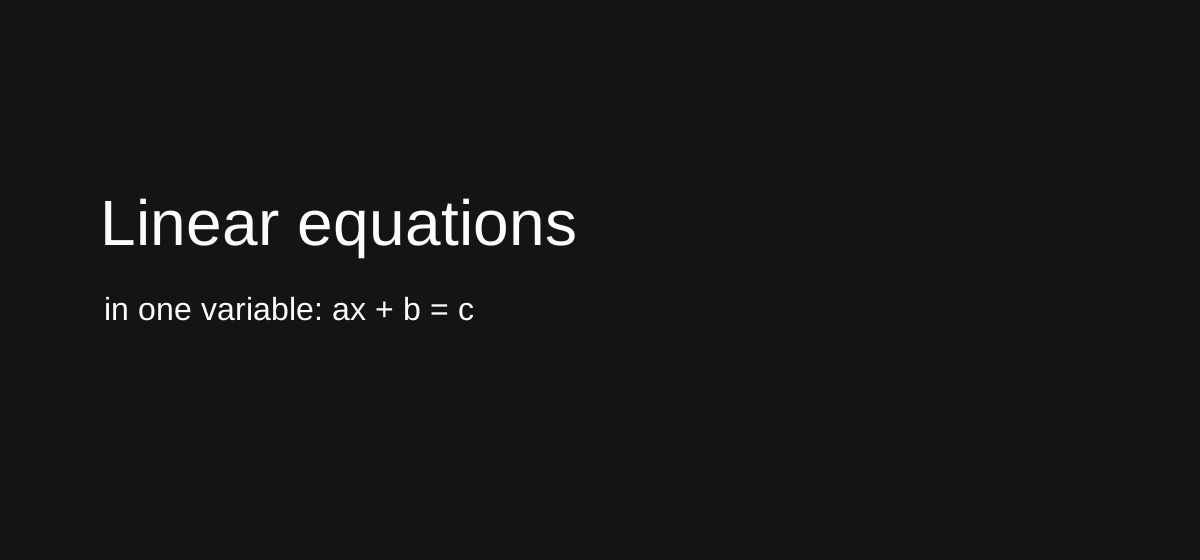
SAT linear equations in one variable practice is about preserving equality while you isolate an unknown. The equation may contain parentheses, fractions, or variable terms on both sides. Simplifying it carefully matters more than guessing which operation comes next.
MockingBear’s question taxonomy places this skill in Math → Algebra. Start with the skill check to identify what needs work, then use Algebra practice to work on the steps that caused trouble.
What this SAT Math skill covers
A linear equation in one variable has variable terms that reduce to degree one. You may be asked to find the variable, find a related expression, or decide whether the equation has one solution, no solution, or infinitely many solutions.
MockingBear’s skill taxonomy names solving an equation and classifying solutions as parts of this skill. Its listed traps include an operation applied to only one side, a distribution error, an incorrect inverse operation, and confusion about the number of solutions.
A method for solving and checking
Read what the question asks for before rearranging anything. Distribute across every term in parentheses, combine like terms, and perform the same operation on both sides. Collect the variable terms, then isolate the requested value.
Substitute the result into the original equation. Checking the simplified equation alone can hide an earlier sign or distribution error. If the question asks for an expression rather than the variable, use your result to evaluate that expression.
If the variable terms cancel, inspect the remaining statement. A true equality means every permitted value satisfies the equation; a false equality means there is no solution. Do not divide by a variable coefficient before considering whether it could be zero.
A worked linear-equation example
MockingBear practice example: If 5x − 12 = 3x + 8, what is the value of x?
Subtract 3x from both sides and add 12 to both sides: 2x = 20. Divide both sides by 2 to get x = 10. Substituting into the original equation gives 38 on both sides.
A useful review note names the step that failed. For example, if you moved −12 without changing its sign, practise applying the same addition to both sides before trying a more complicated equation.
What practice in MockingBear looks like
Start with the skill check. It identifies skills needing work and does not give an SAT score. Use that result alongside the errors you notice in your own solutions to choose a follow-up topic.
In the question bank, choose Math, then Algebra. Algebra practice includes several skills, so a set can contain questions beyond linear equations in one variable.
Practice sets let you work at your own pace and review explanations where available. For an equation you miss, compare your steps with the solution, write down the first point where they differ, and try solving it again without the explanation open.
For pacing practice, MockingBear’s timed tests use fixed modules. A completed test’s replay shows answer changes and time per question. Use that history to identify which algebra steps need more deliberate practice.
MockingBear practice and review featuresHow to review an SAT practice test
Choose the next step
If equivalent operations are still uncertain, stay with straightforward equations until you can explain each step. Then practise equations with parentheses, fractional coefficients, or variables on both sides. These are variations within the same skill, not promises about the contents of your next set.
Desmos can help you check an equation graphically, but the result still needs to answer the question asked. For broader preparation, combine targeted practice with a study plan and official Bluebook practice for the adaptive format.
Use the SAT score calculator for an estimate, not to measure mastery of this one skill. Start the skill check when you are ready to identify what to study next.
Desmos for SAT MathA four-week SAT study planSAT score calculatorSAT prep comparisonsAll SAT study guides
SAT trademark notice
SAT® is a registered trademark of the College Board. MockingBear is not affiliated with, sponsored by, or endorsed by the College Board.
Sources
Details checked:
MockingBear featuresHow MockingBear worksCollege Board: Bluebook practice tests
See the linked sources for current test rules and product details.